ADHD Journaling: How to Build a System That Actually Sticks
My husband is on some spectrum. Suggest journaling to him and he does not get skeptical or dismissive. He panics. Someone mentioned it in passing once, no notebook in sight, just the idea of one, and he went quiet. The conversation was over.
I am the planner in this house. Color-coded calendars, weekly spreads, the lists that actually get followed: that is my territory. I filed his reaction away as his thing and did not push.
A week later I walked into the kitchen and he was standing at the counter with a pen in his hand. He had meant to write one thing down before he forgot it. Five seconds of work. He cannot leave a task half-done. It is not how he is wired. So he stood there waiting for the thought to come back. It did not. He set the pen down. He never wrote a word.
I started recognizing that look in other places. The structured daily planner that had him three weeks behind by day four. The plain notebook that sat on his nightstand for six months because every time he picked it up, the blank page asked for more than he had. The journaling app he opened on a Wednesday night with real intention and never opened again. That is not laziness. It is a brain that has been burned enough times to stop trusting the setup, and what looks like resistance is closer to self-protection.
Most journaling advice assumes a brain that wakes up at the same time every day, remembers where it left the notebook, and can summon motivation on demand. "Write three pages every morning." "Keep it consistent." "Just show up." None of that works when your executive function is unreliable by design. This guide skips all of it. Instead of asking you to be more disciplined, it focuses on lowering friction until journaling becomes the path of least resistance. By the end, you will have a setup you can actually reach for on a Tuesday at 11pm when your brain is running on fumes.
Small, ugly, inconsistent entries beat the perfect journal you never open. That is the whole point.
In this article
Why Standard Journaling Advice Fails ADHD Brains
ADHD affects working memory, time perception, and motivation regulation. These are not minor inconveniences when it comes to building any habit. Working memory means you may genuinely not remember where yesterday's journaling session happened. Time perception means the "every morning" window shifts each day and keeps slipping past. Motivation regulation means the version of you who was excited about journaling last Tuesday feels like a different person today.
Habit-stacking journaling onto something you already do looks good on paper. In practice, it depends on consistent executive function, and executive function with ADHD is not consistent. Some days the cue works perfectly. Other days the same trigger that worked for three weeks simply does not register.
"Just do it every day" also fails to account for one of the most common ADHD experiences: you cannot find the journal. Not because you are disorganized, but because yesterday's motivated version of you put it somewhere logical and today's brain cannot retrace that logic. The journal disappears. The streak breaks. The whole project starts to feel like evidence of failure.
Make the Journal Itself Appealing

Visual stimulation is functional for ADHD brains, not decorative. A journal that looks interesting on your desk catches your eye. You pick it up. The encounter starts before you have made any deliberate decision. That involuntary moment of noticing is what you are actually designing for.
Plain notebooks are not bad. They just require a conscious choice every single time. A journal that is visually compelling reduces that choice to something close to automatic, especially when it stays somewhere visible rather than stored tidily out of sight.
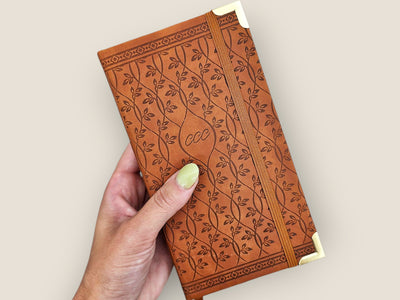
The Vintage Mini Journals work well for this reason. They are small enough that they do not feel like a commitment, and attractive enough to keep on a desk. The small size matters more than it might seem. A full-size journal can feel like it requires a full-size effort. A pocket journal feels like a quick conversation you can have and put back down.
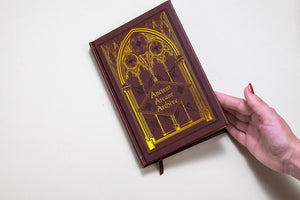
If you want something with real tactile weight, the Ancient Arcane Foil Notebook catches light and has a presence that makes it feel worth opening. That sounds like a small thing. It is not. Out of sight is out of mind for ADHD brains in a way that is very literal. Whatever journal you choose, keep it visible.
Use Color-Coding & Symbols With Washi Tape

Color-coding works for ADHD brains because it bypasses reading entirely. A stripe of washi tape along a section edge tells you what that section contains before you have read a single word. Your eye does the work your working memory cannot reliably do.
The system does not need to be elaborate. One or two colors is plenty. The one I keep coming back to: one color for tasks and to-do items, a different color for things I noticed or felt. Same logic for symbols: one recognizable shape for tasks, a different one for observations. Anything more and the system itself becomes the thing that needs managing, which defeats the purpose.
The Roll of Arms Cutout Tape brings the symbol straight into the spread for you. The die-cut crests act as visual anchors along the edge of an entry, so your eye finds the section by shape before it tries to read a label. One tape, no drawing required.
For categories you want to flag and return to, the Celtic Vibes Washi Tape Set gives you several knotwork patterns in one set. A different pattern per category lets you color-code and symbol-code at the same time without buying more tape than you need. For quieter section markers, the Burnt Edges Washi gives structure without visual noise.
Our washi tape collection has cutout shapes, patterned sets, and quiet neutrals. One roll is all you need to start dividing your journal by color.

One strip of washi tape does more organizational work than three paragraphs of notes
Stickers as Visual Anchors

Stickers are not decoration for ADHD journalers. They solve the blank page problem. A completely empty page has no obvious starting point, and that ambiguity is enough to stop many people before they have written a word. A sticker placed before you start writing gives your eye something to organize around. The page is no longer blank. Your job becomes adding to something rather than filling a void.
The Herbal Magic Sticker Tin contains small, flat stickers that sit quietly on a page without taking it over. For mood entries and self-compassion days, the Affirmations Stickers give the page an intention before you have written anything. On the hard days, that can be enough to make starting feel possible rather than heavy.

Affirmations Stickers: a visual anchor and a genuine self-compassion prompt before you write a word
For days when the journal should feel like a reward for showing up, the Mystical Woodlands Sticker Book has enough decorative richness to make opening the journal feel like something you want to do. If you enjoy decorating the page, that enjoyment is the whole point. It keeps you coming back.
One tin gives you enough variety to anchor any blank page without overcommitting. Small, flat stickers that sit quietly on paper — not art-project-level elaborate, just enough to make starting easier.
Supply Tiers: Start Simple, Build Slowly
One of the ADHD traps with journaling: buy everything at once, use it intensely for two weeks, and then abandon the whole system when it does not become a habit overnight. Start small instead. Add one thing when the previous thing is genuinely part of how you journal. Here is a progression that actually works:
One small journal kept visible, one washi tape for section dividers. No commitment needed.
Shop JournalsAdd a sticker tin and a second washi color. Now you can color-code and anchor pages visually.
Shop StickersA foil notebook, a full washi tape set, and a sticker book. At this point journaling becomes a creative practice.
Shop WashiA monthly craft subscription box. Everything curated and delivered when your supplies run low.
Shop BoxesThe Minimum Viable Journal Entry
The minimum viable entry is whatever you can manage on a hard day. "Tired. Ate well. One good conversation." That tells you something useful when you read it back later. It keeps the habit alive. It matters.
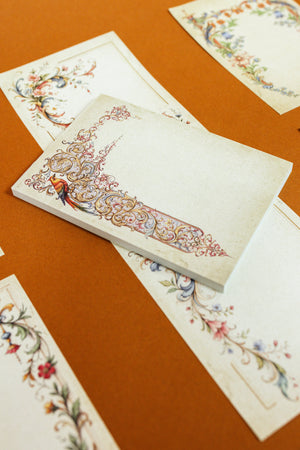
For unstructured brain dumps, the Illuminated Frames Notepad II carries less weight than a bound journal. A notepad does not feel precious. You write what is in your head, tear the page off if you want to, and keep going. The activation energy is lower. Brain dumps are supposed to be messy, not good, and a notepad gives you permission to do that.
Check each one off as you do it. Your progress saves automatically.
Time Blindness and the Journal
Time blindness does not get talked about enough relative to how much it affects daily life. It is not poor time management. It is a genuine difficulty perceiving how much time has passed, how long something took, or how far back an event was. In journaling, it shows up as the shame spiral when you open a dated planner and count the empty days since you last wrote.
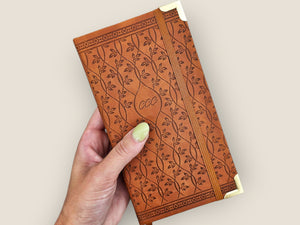
The Vintage Planner Undated works this way. You write the date yourself when you use it. A two-week gap looks identical to a one-day gap from the outside of the journal. The visual evidence of skipped time disappears.

A washi-bordered habit tracker in an undated planner: structure without the shame of blank dated pages
Making It Sensory

ADHD often involves sensory-seeking behavior: reaching for inputs that are interesting to touch or handle. You can use this deliberately. Supplies that feel good lower the barrier to starting, because picking them up is already rewarding before you have written anything.
Paper texture matters more than most journaling advice admits. The Whispers of the Countryside Rice Paper feels noticeably different from standard journal paper. Softer, slightly fibrous, with a surface that makes you want to put something on it. That is not a frivolous reason to choose it. It is a practical one.
Washi tape works this way too. Peeling and pressing a strip down has a small, satisfying finality that makes a page feel started. The Mystical Forest Transparent Tape has enough visual interest to make dividing a page feel like an intentional act rather than a chore. Small frictions removed, one at a time, are how habits actually form.
What to Actually Write
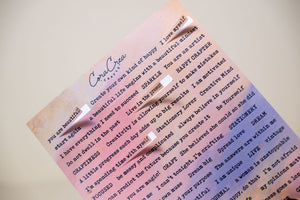
Keep the formats simple enough to use on the worst days. Here are the five that work most consistently:
- Daily brain dump: Everything currently in your head, in any order, with no structure required. Five sentences counts. The point is to move things out of working memory and onto paper.
- One good thing + one thing to carry forward: Two lines maximum. What went well today, and one thing worth remembering tomorrow. Quick enough that even a bad day has no real reason to skip it.
- Mood color: Draw three small circles and color them in with whatever color matches how you feel right now. It sounds trivial. It is faster than a paragraph and often more honest.
- A line that landed today: From a book, a conversation, a song. Just the quote, no commentary needed unless you want to add some.
- One thing you actually did: Not a to-do list. One completed thing, acknowledged. ADHD brains move on without registering what was already done. Writing it down makes it real.
None of these require a full page. All of them leave something worth reading back. Reading back is where journaling pays off for ADHD specifically: it surfaces patterns your working memory never kept, because working memory does not work that way. The journal does.
Supplies That Work With Your Brain, Not Against It
Everything in this guide is available at CoraCreaCrafts. If you are just getting started, one journal, one roll of washi tape, and a small sticker tin is plenty. Add to it once journaling already feels like something you want to come back to.

Small formats that do not feel like a commitment, pretty enough to keep on your desk.
See it on Shopify
Color-code your entries so you can find anything in under three seconds.
See it on Shopify
Visual anchors that solve the blank page problem before you write a word.
See it on ShopifyFrequently Asked Questions
Tap any question to expand it. The longer explanations are in the article above.
Yes, and there is good reason for it. Journaling externalizes working memory, which is one of the core functions that ADHD affects most consistently. Writing things down means you do not have to hold them in your head, which reduces cognitive load and frees up attention for whatever you are actually doing. A journal also creates a record of patterns your brain would not naturally track: how often you sleep well, what makes a good day, which situations reliably drain you. That kind of information is genuinely useful. The important caveat is that standard journaling advice is often written for neurotypical brains, so the system needs to be adapted to work with ADHD rather than against it.
Make the system as forgiving as possible, starting with the physical object. An undated planner or small notebook means there are no skipped days to feel bad about. Keep it visible rather than stored away. Make it beautiful enough that you genuinely want to pick it up. And lower the bar for what counts as an entry: one sentence, a date and three words, a mood color. The goal in the early stages is not to write well or write much, it is just to establish the habit of reaching for it. Once that becomes natural, you can build on it.
Small enough not to feel overwhelming, visually interesting enough to keep out in plain sight, and undated so you cannot fall behind. The Vintage Mini Journals work well because they are compact and pretty without requiring a commitment to a full-size book. If you want something with more weight and presence, the Ancient Arcane Foil Notebook is worth considering: the foil cover catches light and makes it feel like an object worth picking up. For a more planner-style approach, the Vintage Planner Undated removes the anxiety of blank dated pages entirely. The right journal is the one you will actually use, which usually means the one that is easiest to reach for.
It can, but the traditional bullet journal setup often creates its own barrier. The elaborate monthly spreads, habit trackers, future logs, and index pages are satisfying to plan and genuinely painful to maintain when executive function is inconsistent. What works better is borrowing the core idea from bullet journaling: rapid logging, where you note tasks, events, and observations in a quick shorthand without worrying about formatting or completeness. That part is genuinely useful for ADHD. The elaborate spreads are optional and worth skipping unless you actually enjoy making them, in which case they can be a reward rather than a requirement.
A brain dump is the practice of writing everything currently in your head onto paper in one go, without structure, filtering, or any expectation of it being useful or readable. You write whatever is there: worries, tasks, random thoughts, things you need to remember, things you are annoyed about. The point is not to produce good writing. It is to clear working memory by moving its contents somewhere external. For ADHD brains, which often run with a lot of simultaneous noise, a brain dump can create a noticeable sense of relief and make it easier to focus on whatever you are supposed to be doing next. A separate notepad, rather than a bound journal, works well for brain dumps because it removes the pressure of putting messy writing into something precious.
See also
Happy journaling,
More from the Blog

22 June 2026
Cyanotype Journal Pages: Easy Sun Prints, No Drawing

14 June 2026
Pressed Flower Journaling 2026

14 May 2026
How to Start a Junk Journal in 2026

6 May 2026
Washi Tape vs PET Tape: The Difference

18 April 2026
Mother's Day Stationery Gift Guide 2026: For the Journaler in ...

18 April 2026
Travel Journal Setup Guide for Beginners | CoraCreaCrafts