Junk Journal vs Bullet Journal: Which One Is Right for You?
- Mixed-media art practice
- Found & collected materials
- Process-driven and freeform
- No required format or rules
- 1–4 hours per session
- Task & life organization system
- Any notebook and a pen
- Goal and habit driven
- Specific rapid logging method
- 2–10 minutes daily
What a Junk Journal Is
Junk journaling started as a practice of stitching together found paper into handmade books. The name comes from the materials: old envelopes, torn pages from discarded novels, brown paper bags, newspaper clippings, packaging inserts. Nothing fancy, nothing bought specifically for the purpose. You gathered what was around you and made something with it.
There is no fixed format. Some people use their junk journals as memory books, layering photographs and ticket stubs into pages that document a specific trip or season. Others treat them as ongoing art projects with no particular subject, just a place to experiment with layering and composition. Seasonal documentation, gratitude collections, nature journals, dream records: all of these are valid. The format accommodates whatever you bring to it.
What goes into a junk journal? Old book pages, envelopes, packaging, tissue paper, kraft paper, rubber stamps, washi tape, wax seals, fabric scraps, pressed flowers, paint, collage imagery, magazine cutouts. The randomness of found materials is part of the design. A page might combine 1970s wallpaper samples with a stamped botanical image and a strip of torn music score. Whether those things "go together" is entirely your call. Junk journaling gives you permission to ignore coordination rules.
Junk journaling has its recognizable looks: warm tones, layered textures, vintage botanical prints. These are preferences the community settled on, not rules anyone set. Certain visual communities have formed around specific sensibilities: cottagecore, dark academia, cottage gothic, nature journal. These are tendencies, not requirements. Your junk journal does not need to look like anyone else's.

find your perfect base: whether you're drawn to a vintage style with natural paper, a thin journal, refillable, or a binder style that can expand forever (almost), there's a perfect base for everyone!
What a Bullet Journal Is
Ryder Carroll developed bullet journaling around 2013. His original goal was a fast, flexible system for capturing tasks, events, and notes without the friction of traditional planners. He published the method publicly and it spread. By the mid-2010s it had its own online community, its own shorthand, and a devoted following among people who had tried and abandoned standard planners.
The core concept is rapid logging. You use a simple notation system: a dot for tasks, a circle for events, a dash for notes. At the end of the month, you review your unfinished tasks and migrate them forward into the next month or remove them if they no longer seem worth doing. This migration process is one of the method's most useful features. It forces you to actively decide what stays in your life and what was never that important to begin with.
In its original form, a bullet journal is minimal. Ruled or dotted pages, hand-drawn grids, a notation key at the front. Nothing elaborate. Carroll's own example spreads are clean and utilitarian. The system was built for people who wanted to write things down fast and find them again without much overhead.

The community took the format somewhere different. Instagram and Pinterest filled up with bullet journal spreads featuring illustrated headers, hand-lettered titles, watercolor washes, weekly layouts with color-coded habit trackers, and intricate borders. Decoration became a genre in itself. Many people started bullet journaling for the planning system and stayed for the creative practice. Decoration is entirely optional. The system works just as well in plain ink, but the decorated version is what most people encounter first.
Sticker Accents for Bullet Journal Pages
Clear stickers and affirmations sticker sets are a low-effort way to add visual interest to bullet journal spreads without committing to hand-lettering or watercolor. The clear background on fountain pen stickers means they sit flat on your page without blocking what's underneath, which keeps your tracker layouts readable while still looking finished.
How They Differ

The most direct way to put it: a junk journal is primarily an art object you build, and a bullet journal is primarily a system you use. That distinction shapes everything else about them. When you sit down with a junk journal, you are making something. When you sit down with a bullet journal, you are doing something: logging, reviewing, planning. The satisfactions are different.
A junk journal is an art object you build. A bullet journal is a system you use. The satisfactions are entirely different.
Junk journaling is process-heavy in a way that bullet journaling is not. The making of the page is the point. Many junk journals have surprisingly little writing in them. Pages might contain nothing but layered paper, stamped images, and a few words cut from a book. That is fine. The journal is an object you are constructing, not a record you are keeping. The time you spend on a single page (selecting materials, tearing edges, gluing things in place, adjusting and rearranging) is the activity. The finished page is the product.
Bullet journaling is task-driven. Pages exist to track something: a to-do list, a habit streak, a reading log, a mood pattern. Decoration is secondary and optional. Some bullet journalers decorate extensively; others write in pencil on graph paper and never add a single embellishment. Either approach satisfies the system's purpose because the purpose is information management, not artistic expression.
Materials reinforce this divide. Junk journaling uses mixed media. Glue, paint, stamps, fabric scraps, found paper, wax seals, pressed botanicals: the medium is inherently physical and tactile. Bullet journaling stays close to pen and paper, though stickers are a common addition for people who want some decoration without the time investment of drawing. A junk journaler needs glue and time. A bullet journaler needs a notebook and a pen. Both are valid starting points; they just lead somewhere different.
Junk Journaling
Bullet Journaling
Who Suits Each Style

Junk journaling tends to suit people who collect objects and paper without quite knowing why. If you have a box of old envelopes somewhere, a drawer of interesting packaging, a small pile of cards you have been meaning to do something with. That instinct toward keeping and accumulating is exactly what junk journaling channels. People who find blank pages exciting rather than intimidating usually take to it quickly, because the format invites filling rather than composing. You do not need to know what the finished page will look like before you start.
It also suits people who prefer process over finished product. If you are the kind of person who enjoys the act of making more than the result of having made, junk journaling fits that preference. There is no performance pressure and no external standard of completion. Comfort with imperfection helps too. Wrinkled glue, a smudged stamp, a layer that did not land quite right. These become part of the texture rather than problems to fix.
Bullet journaling tends to suit people who keep lists of lists. If you have multiple to-do apps open right now, or if you have started new notebooks to consolidate your notes and ended up with three half-finished systems running in parallel, the bullet journal's single-notebook approach often cuts through that chaos. It works well for people who want a reason to open a journal each day, who track habits or goals, who feel more at ease when things are written down and accounted for.
People who have started many notebooks and abandoned them midway through are often better served by bullet journaling than by junk journaling. The bullet journal gives you a daily reason to return to it. Junk journaling, by contrast, rewards people who are comfortable picking it up and putting it down as inspiration comes and goes. There is no log to maintain, no migration to complete, no ongoing system that breaks if you skip a week. Some people want both, and there is no reason they cannot coexist. Many crafters keep a junk journal for creative work and a bullet journal for planning, using each for its intended purpose without asking either to do the other's job.
You might love junk journaling if…
You collect paper and interesting objects without quite knowing why
You enjoy the making process more than the finished result
Blank pages feel like an invitation, not pressure
You're comfortable picking up a creative project on your own schedule, with no pressure to continue daily
You might love bullet journaling if…
You keep multiple to-do lists and planning apps running at the same time
You feel steadier when tasks are written down and accounted for
You want a reason to open a journal every day, not just when the mood strikes
You track habits, goals, or moods and like seeing patterns over time
Getting Started: Junk Journaling
You do not need a kit to start. Collect paper first. Old book pages, cereal box cardboard, packaging inserts, magazine pages, envelopes from bills you have already dealt with, brown paper grocery bags: anything printed or textured will work. Spend a week noticing what you throw away and setting some of it aside. By the end of the week you will have more material than you need for your first journal.
Your first journal can be as simple as folding and stapling found paper into a booklet. Take eight to ten sheets of similar-sized paper, fold them in half together, and staple along the spine. You have a book. It does not need a cover, though a piece of cereal box cardboard cut to size makes a solid one. Tear or cut the pages to make them uneven. Nothing about this needs to be perfect, and in fact the rougher construction tends to give you more freedom once you start filling the pages, because you are not worried about preserving something precious.

Basic supplies help once you have the format figured out. A roll or two of washi tape gives you a quick way to attach things and add borders. One or two rubber stamps expand what you can mark pages with. Some form of glue or matte medium holds layers in place. Scissors, though tearing often produces better results anyway. From there, stickers and paper cutouts let you add decorative imagery without needing to draw it yourself, which matters a lot if you feel uncertain about your artistic skills.
Building the habit is simpler than it sounds: set aside an hour and make one page. Do not plan it. Pull out a few pieces of paper you have collected, pick one as a background, and start layering things on top of it. See what happens. The first page is always the hardest because the journal feels too blank to touch. Once one page exists, the next one becomes easier.
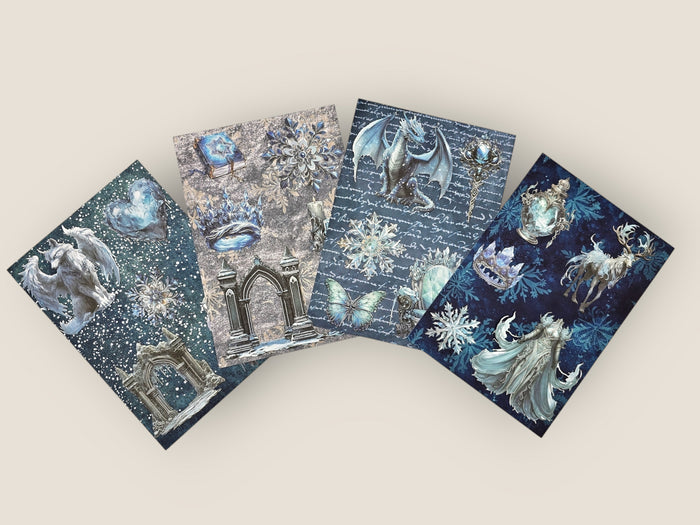
Paper cutouts like the Winter Fantasy Cutouts ($10.00) give you ready-made ephemera to layer into junk journal pages without having to hunt for vintage materials.
Ephemera and Finishing Touches
The Specimen Ephemera Mysteries of the Night Cutouts ($10.00) bring botanical and nocturnal imagery for pages that lean darker or more natural. Writer Collection Premade Wax Seals ($25.00) add a tactile finishing element that photographs well and makes pages feel deliberately finished rather than simply complete.
Craft finds and free printables
Washi tape picks, seasonal printables, and journal prompts worth keeping. One email, whenever there's something worth sending.
You're in. Your first picks are headed to your inbox.
Getting Started: Bullet Journaling
Start with one notebook and a pen. Any notebook works. Some people insist on dotted grid paper, and dotted paper is genuinely easier for drawing trackers and keeping your writing aligned, but a plain ruled notebook or a blank composition book gets the system running just as well. Buy the nicest notebook you can bring yourself to actually write in, not the nicest one you can find. Precious objects make bad daily planners.
Setting up your first bullet journal takes about 30 minutes. Number your pages if they are not already numbered. Leave the first two pages blank for an index, where you will log page numbers for collections and logs as you create them. Set up a future log on the next few pages: two months per spread, where you can note upcoming events and deadlines that fall outside the current month. Then create your first monthly log: one page for a calendar view of the month, and one page for a monthly task list. After that, start a daily log and begin rapid-logging.
First Bullet Journal Setup — 5 Steps
- Number your pages — if not pre-numbered, add them by hand in a corner
- Create an index — first two pages; fill it in as you add logs and collections
- Add a future log — next 4–6 pages; two months per spread for upcoming events
- Start a monthly log — calendar view on one page, task list on the facing page
- Open a daily log — date the next blank page and begin rapid-logging today
Migration is the part that keeps the system honest. At the end of each month, go through your unfinished tasks. For each one, decide: does it still matter? If yes, write it into the next month's task list. If no, cross it out and let it go. This review process is uncomfortable in a productive way. Tasks that you migrate twice without completing are usually tasks you are not actually going to do, and the system makes that visible.

Decoration is fully optional. Some bullet journalers spend hours each week on illustrated spreads and hand-lettered headers. Others write in fast, functional shorthand and never add a single decorative element. Both approaches use the same system and produce the same organizational result. If decoration interests you, Fountain Pens Clear Stickers can be a useful first add-on - they add visual structure to your pages without requiring drawing skill or extra time.
Can You Do Both?

Yes, and many people do. Junk journaling and bullet journaling are different enough that keeping both does not create much overlap or conflict. One is a creative practice; the other is an organizational system. They meet different needs at different times. A junk journal gives you somewhere to put your hands when you want to make something without a screen. A bullet journal gives you somewhere to put your tasks so they stop cycling through your head at inconvenient moments.
Keeping them separate is the main practical advice. Trying to make a single notebook serve both purposes tends to produce something that does neither well. The art pages slow down the daily planning, and the planning pages feel out of place in an art object. Two separate notebooks, each used for its own purpose, is the cleaner arrangement. If carrying two notebooks feels like too much, use a small pocket notebook for daily bullet logging and a larger format book for junk journaling at home.
One notebook for making things. One notebook for tracking things. They don’t compete - they complement.
Frequently Asked Questions
Whatever You Decide, Start This Week
The best journal is the one you actually open. Whether you are building pages or logging tasks, these collections have what you need to get started.
Junk Journal Supplies
Papers, ephemera, and decorative elements for building and layering your pages from scratch.
Browse SuppliesWashi Tape
Borders, accents, and page dividers for both junk journals and bullet journal spreads.
Browse Washi TapeStickers
Clear stickers, themed sets, and affirmation stickers that work across both journal styles.
Browse StickersSee also
Happy journaling,
More from the Blog

22 June 2026
Cyanotype Journal Pages: Easy Sun Prints, No Drawing

14 June 2026
Pressed Flower Journaling 2026

20 May 2026
ADHD Journaling: How to Build a System That Actually Sticks

14 May 2026
How to Start a Junk Journal in 2026

6 May 2026
Washi Tape vs PET Tape: The Difference

18 April 2026
Mother's Day Stationery Gift Guide 2026: For the Journaler in ...